
How to Shrink Your Agent Package and Pay Less Shipping
By Chen Hong Jie · Updated · 4 min · Español · Italiano
Quick answer
If your package is billed by dimensional weight, every inch counts. The biggest savings come from removing shoe boxes and retail packaging, vacuum-packing bulky clothes and keeping rigid items out of soft-goods boxes. Run the numbers before and after in a DIM weight calculator to see what you save.
The fastest way to lower your shipping bill from a shopping agent is to make the package physically smaller: remove shoe boxes and retail packaging, vacuum-pack bulky clothes, and keep rigid items from dictating the box size. That only pays off if your package is billed by dimensional (DIM) weight, so check that first. For a typical clothing-and-sneakers haul, it usually is.
Step 1: Are you paying for weight or for size?
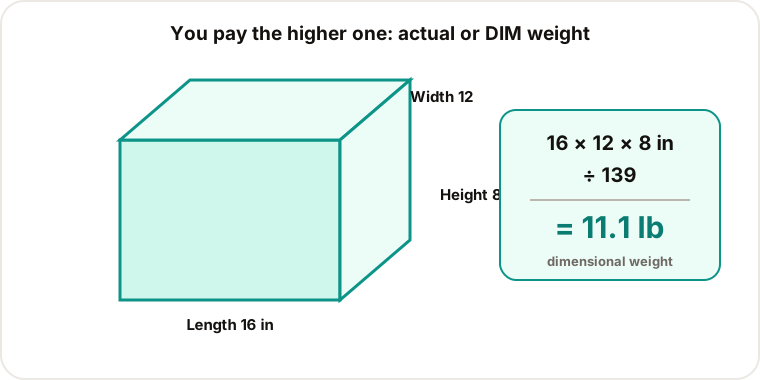
Carriers charge for whichever is higher: the actual weight or the DIM weight. DIM weight is the box’s volume divided by a divisor:
- Inches and pounds: length × width × height ÷ 139 or 166 (common carrier divisors that vary by service).
- Centimeters and kilograms: length × width × height ÷ 5000, 6000 or 8000 (what most agents list).
Plug your rough measurements into the dimensional weight calculator. It works in inches and pounds by default, lets you switch to cm and kg, and tells you whether you’re paying for size. If the answer is “size,” keep reading.
Quick example: a 16 × 12 × 8 inch box that weighs 4 lb has a DIM weight of 16 × 12 × 8 ÷ 139 = 11.05 lb. You’d pay for about 11 lb, not 4.
Step 2: The five moves that shrink a package most
1. Remove the original boxes
Sneakers, headphones, watches and small electronics come in bulky retail boxes. Ask your agent to remove them. A sneaker box can easily take up about twice the space of the pair itself, so this is usually the single biggest win.
2. Vacuum-pack bulky clothing
Hoodies, puffer jackets, fleece and heavy sweatpants are mostly air. Vacuum compression can shrink them dramatically. Most agents offer it as a paid add-on at checkout or during the shipping step.
3. Group items by shape
One large rigid item, such as a structured backpack or a shoe box you want to keep, sets the minimum box size. If you can, ship it separately or stuff soft items inside it so the space isn’t wasted.
4. Ask for a tighter box
Some agents will repack into a smaller carton or a poly mailer bag. That works well when everything inside is soft.
5. Skip unnecessary extra padding
Reinforced packaging and extra bubble wrap add inches. Save them for fragile items like ceramics, glass or electronics.
Example: before and after
| Scenario | Box size | DIM weight (÷ 139) | Billed as |
|---|---|---|---|
| 2 pairs with boxes + 2 hoodies | 18 × 14 × 12 in | 21.76 lb | about 21.8 lb |
| No shoe boxes + vacuum-packed hoodies | 16 × 12 × 6 in | 8.29 lb | about 8.3 lb (if actual weight is lower) |
Illustrative only: your real numbers depend on the items and how the agent packs them. The divisor also depends on your shipping line.
The same box in metric: 18 × 14 × 12 in is about 45.7 × 35.6 × 30.5 cm, which works out to roughly 9.9 kg on a ÷ 5000 line. Switch the calculator to cm/kg if your agent quotes that way.
Step 3: Services to request from your agent
| Service | Use it for |
|---|---|
| Remove boxes / packaging | Sneakers, electronics, accessories |
| Vacuum compression | Hoodies, jackets, bulky knits |
| Repack / smaller carton | Soft-goods hauls |
| Package photos | Checking contents and size before you pay shipping |
| Consolidation | Combining orders into one package |
Names and prices for these services vary by agent. You’ll usually find them in the step where you create the shipment, often under “value-added services.”
Step 4: Consolidate, but not blindly
Combining everything into one package usually saves money because many lines charge a first-weight fee plus a lower rate for each extra unit. But one huge, airy box can cost more than two compact ones. A few rules of thumb:
- Consolidate soft goods together, and keep rigid items in a separate box when they would waste space.
- Ask for package photos with a tape measure before paying international shipping.
- Re-run the DIM weight calculator with the real measurements the agent gives you.
- Compare at least two shipping lines in the agent’s estimator; their divisors and rounding rules differ.
Don’t forget duties
A smaller package lowers shipping, but it doesn’t change what you owe at the border. Since the $800 de minimis exemption was suspended, most parcels from China owe U.S. duties, and how they’re collected depends on the line you choose. Read US import duties on parcels from China before you pick a line, and check the line’s description for whether duties are included.
Quick checklist before you ship
- Checked whether the package is billed by size or weight.
- Asked to remove shoe boxes and retail packaging.
- Vacuum-packed bulky clothing.
- Kept rigid items from inflating the box.
- Compared two or more shipping lines (divisor, rounding, duties).
- Confirmed sizes first with the Chinese size chart words guide, because a return after shipping is far more expensive than one in the warehouse.
When you’re ready to pay, make sure you’re on the agent’s real site. Our guide on paying shopping agents safely covers what to check.
Frequently asked questions
+Does removing the shoe box damage sneakers?
Usually not. Agents wrap the pair in bags or paper and pack it among soft items. Keep the box only if you need it for a gift or resale.
+Is vacuum packing safe for clothes?
For cotton tees, hoodies, sweatpants and puffer jackets it’s generally fine. Skip it for structured items, leather or anything you don’t want creased.
+When is shrinking the package not worth it?
When your package is already billed by actual weight, meaning its DIM weight is lower than what it weighs on the scale. Check with a DIM weight calculator first.
+What divisor should I use to check my package?
Use the one listed for your shipping line in your agent’s estimator. Metric lines often use 5000, 6000 or 8000; carriers that quote in inches and pounds commonly use 139 or 166, but it varies by service.