
Dimensional Weight Calculator (in & lb) for China Hauls
Last updated: 2026-10-23
Quick answer
Dimensional (DIM) weight = length × width × height ÷ a divisor. In inches and pounds, common carrier divisors are 139 and 166; in centimeters and kilograms, agents usually list 5000 or 6000. You pay for whichever is higher: actual weight or DIM weight. Example: a 16 × 12 × 8 in box ÷ 139 = 11.05 lb (about 11.1 lb), even if it only weighs 4 lb.
139 and 166 are common carrier divisors for inches and pounds. They vary by carrier and service, so confirm the one your shipping line uses in your agent’s estimator.
16 × 12 × 8 in ÷ 139
Dimensional weight11.05 lb
Billable weight11.05 lb(about 5.01 kg)
You’re paying for size: shrink the box (ditch shoe boxes, ask for vacuum packing on bulky clothes).
Estimate only. Shipping lines may round weight up (often to the next 0.1 kg, 0.5 kg or 1 lb) and set their own divisor. Always confirm in your agent’s shipping estimator.
How the math works
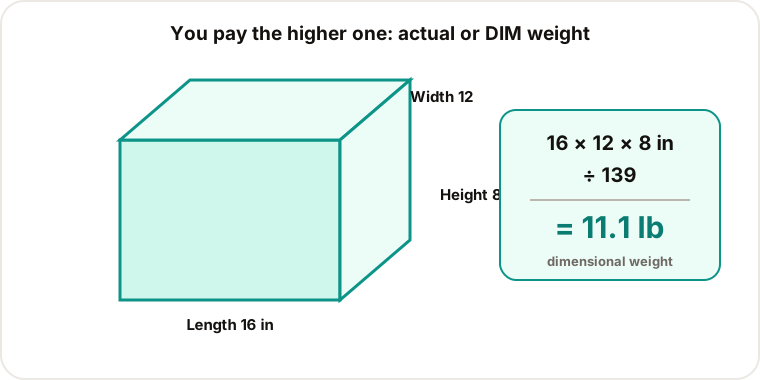
Carriers charge for the space a package takes up, not just what it weighs, so they turn volume into an equivalent weight called dimensional (DIM) or volumetric weight.
Divisors differ by carrier and service. With inches and pounds, 139 and 166 are the ones you’ll see most; a smaller divisor makes your box “heavier” for pricing. Many agents quote lines in metric instead (cm ÷ 5000, 6000 or 8000), so the calculator handles both. Always check which divisor your shipping line uses in your agent’s estimator.
If you’re paying for size, shrinking the box saves the most: ask the agent to remove shoe boxes, vacuum-pack bulky hoodies and jackets, and consolidate everything into one tight package.
Frequently asked questions
+What divisor does my shopping agent use?
It depends on the shipping line, not just the agent. Look at the line details in the agent’s shipping estimator. Metric lines usually say 5000, 6000 or 8000; carriers that quote in inches and pounds commonly use 139 or 166, but it varies by service.
+How do I convert my box from inches to the agent’s metric formula?
Multiply each side in inches by 2.54 to get centimeters, then use the metric divisor. Or switch the calculator to cm/kg and it does the math for you; the result is always shown in both pounds and kilograms.
+Why is my package heavier at the agent than on my scale?
Because you’re billed DIM weight whenever it’s higher than the actual weight. A smaller box lowers the billable weight.
+Does removing shoe boxes really lower the price?
Usually, yes. A sneaker box can take up about twice the space of the pair itself, which adds up fast on lines with a strict divisor.